Earthing: how an earth pit works

What is inside an earth pit, why its resistance must be low, and how to test earthing safely.
A pipe buried in the ground is quietly saving your life 🌍⚡
1️⃣ INSIDE THE PIT: a GI pipe (or plate) about 3 m deep, packed in layers of charcoal and salt that hold water. A funnel lets you pour water in. The green earth wire from your home is clamped on top. Wet soil carries current away easily.
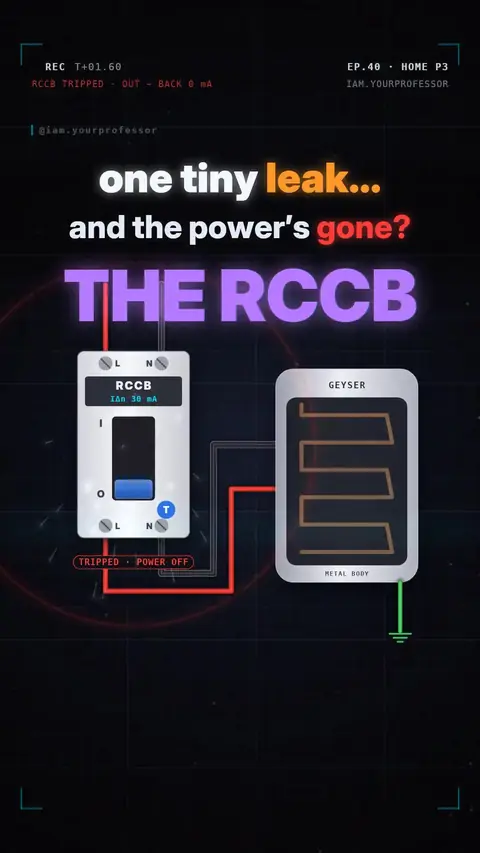
2️⃣ WHY IT MUST BE LOW OHMS: if a geyser's heater leaks to its metal body, the fault current rushes down the green wire into the ground and the protection trips. But a DRY, bad pit (say 100 Ω) lets only 230 ÷ 100 ≈ 2 A flow — a 16 A MCB never trips, and the metal body stays LIVE. An RCCB (30 mA) still trips, which is why you need both.
3️⃣ KEEP IT WORKING: get the earthing tested every year by an electrician with an earth tester, keep the pit moist in dry months, and a neon tester on the earth pin must NOT glow.
⚠️ Earthing work = licensed electrician only.
Read the voiceover (transcript)
- A buried pipe... saves your life?
- Inside: a metal pipe, three metres deep, packed in charcoal and salt. Wet soil carries current away.
- A leak rushes down this wire and trips the power. A dry pit? Barely two amps. The body stays live!
- Get it tested every year, and keep it moist!
- Low ohms keep you alive!
- Next: what is one unit? Follow for part six!
Related lessons



Get new lessons + early access to the full course
One email when new lessons drop. No spam, unsubscribe any time.
✓ You're on the list. Check your inbox to confirm.
By joining you agree to the privacy policy.