// FREE MINI-COURSE · µF
Capacitor Series
Capacitors Explained — How capacitors store energy, keep time and clean up power.
4 of 5 lessons out · next: Why a capacitor blocks DC but passes AC
▶ Start lesson 1- 01
 How a capacitor stores energyCharge builds up on two plates across an insulator; Q = C × V.
EP.07 · 20 s
How a capacitor stores energyCharge builds up on two plates across an insulator; Q = C × V.
EP.07 · 20 s - 02
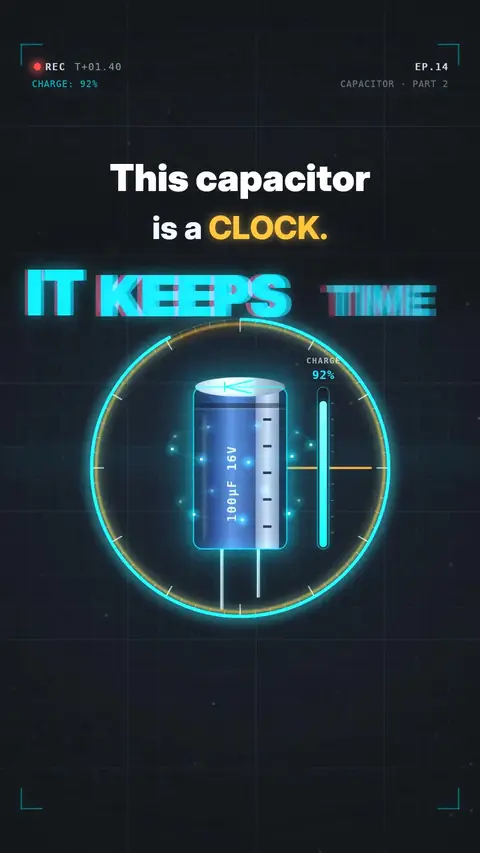 How a capacitor keeps TIMEA resistor makes a capacitor fill slowly: τ = R × C (10 kΩ × 100 µF = 1 s), 63 % after 1τ, full after 5τ — that's a timer.
EP.14 · 20 s
How a capacitor keeps TIMEA resistor makes a capacitor fill slowly: τ = R × C (10 kΩ × 100 µF = 1 s), 63 % after 1τ, full after 5τ — that's a timer.
EP.14 · 20 s - 03
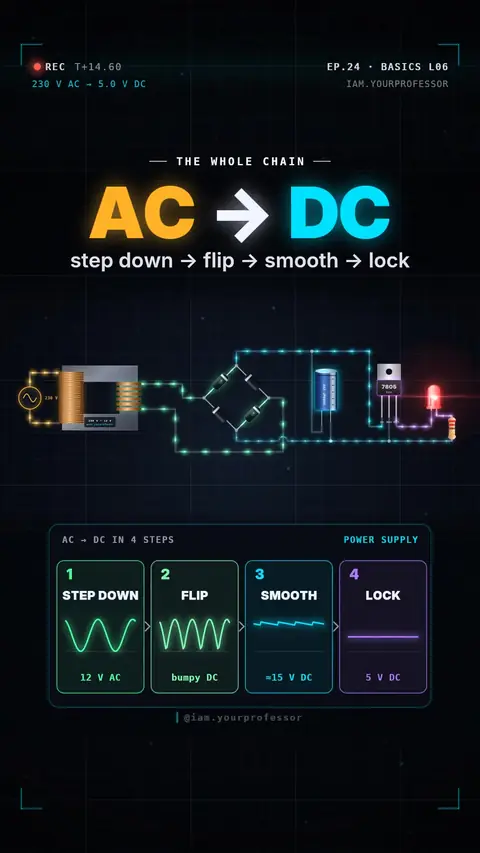 AC → DC: how a power supply makes DCHow a capacitor fills in dips to give steady DC.
EP.24 · 20 s also in Electronics Basics
AC → DC: how a power supply makes DCHow a capacitor fills in dips to give steady DC.
EP.24 · 20 s also in Electronics Basics - 04
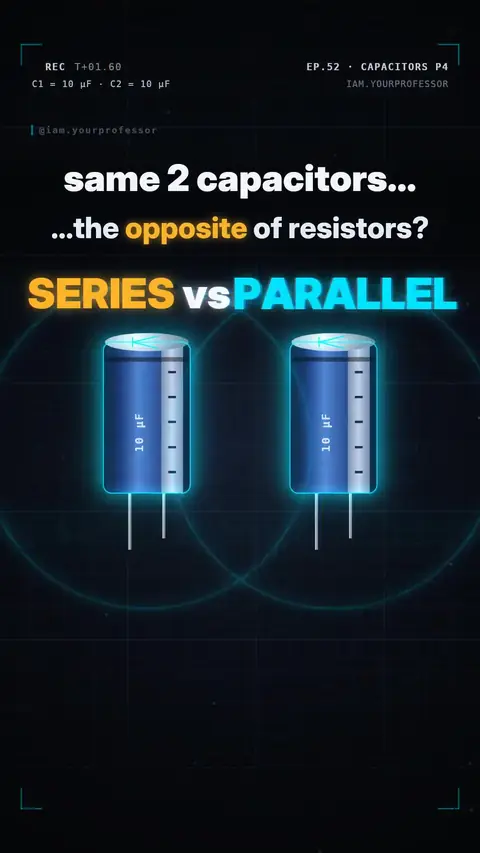 Capacitors in series vs parallelParallel caps add (10 µF + 10 µF = 20 µF, bigger plates); series caps give less (5 µF, bigger gap) but share the voltage: the opposite of resistors.
EP.52 · 24 s
Capacitors in series vs parallelParallel caps add (10 µF + 10 µF = 20 µF, bigger plates); series caps give less (5 µF, bigger gap) but share the voltage: the opposite of resistors.
EP.52 · 24 s - 05 COMING NEXTWhy a capacitor blocks DC but passes ACA capacitor charges up and stops DC, but AC keeps charging and discharging it, so AC gets through (more easily at higher frequency).
// NEWSLETTER · FREE
Get new lessons + early access to the full course
One email when new lessons drop. No spam, unsubscribe any time.
✓ You're on the list. Check your inbox to confirm.
By joining you agree to the privacy policy.