How a DC motor works
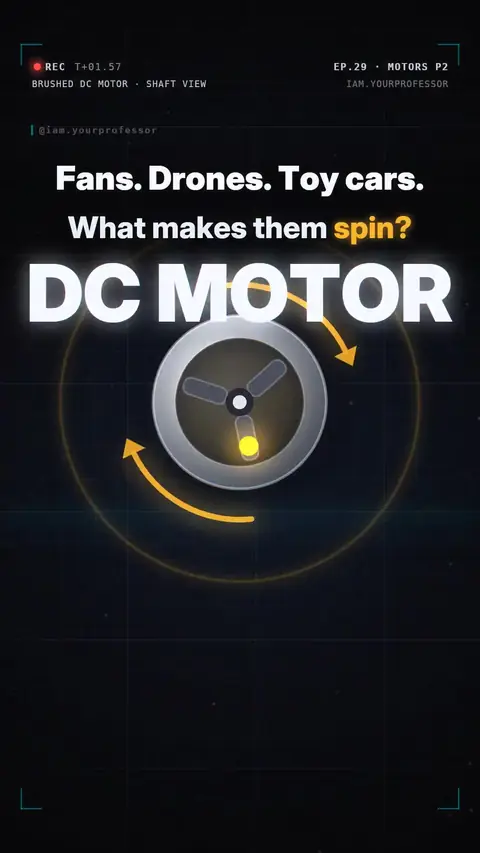
How a brushed DC motor spins: magnets + coil, current in a field gets pushed (F = B × I × L), the commutator flips the current every half turn, more volts = faster, swap + / − = reverse.
How does a DC motor actually spin? ⚙️
The yellow toy motor, the fan, the drone, the RC car: most of them use a brushed DC motor. Inside are just 3 ideas:
1️⃣ MAGNETS + COIL: two magnets (N and S) make a magnetic field. A copper coil sits in the middle.
2️⃣ THE PUSH: send current through the coil and the field pushes the wire (F = B × I × L). One side goes UP, the other DOWN, so it turns.
⚠️ But with fixed wires it only turns half way and then just rocks at the top.
3️⃣ THE FLIP: the COMMUTATOR (split ring) + carbon BRUSHES flip the current in the coil every half turn, so the push never stops and it keeps spinning.
CONTROL: more volts = faster (3 V → 6 V ≈ 2× the speed). Swap the + and − wires = it spins the other way.
(Shown slowed down. Real motors use 3+ coils so they start smoothly from any position.)
Related lessons


Get new lessons + early access to the full course
One email when new lessons drop. No spam, unsubscribe any time.
✓ You're on the list. Check your inbox to confirm.
By joining you agree to the privacy policy.