What does '3 nm' really mean?
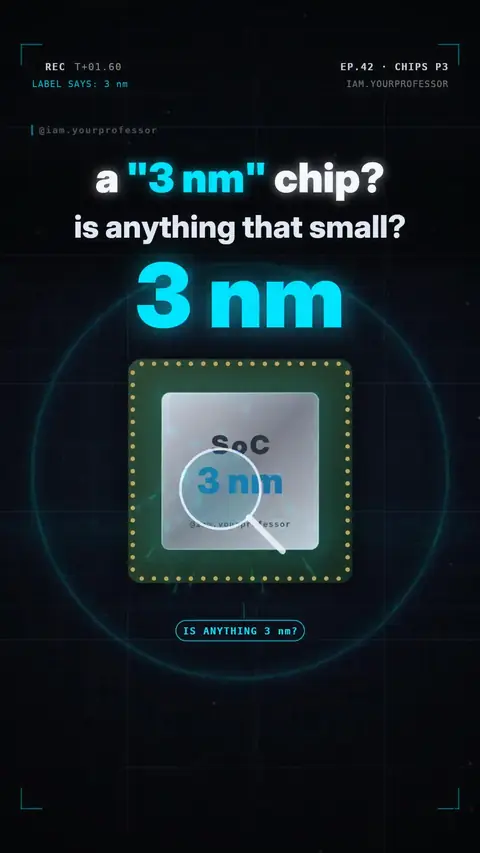
Why chip 'nm' numbers are names for a process generation, not the size of any one part, and how small transistors really are.
Your phone has a "3 nm" chip… but is ANYTHING on it 3 nm? 🤯
1️⃣ HOW SMALL: a human hair is about 80,000 nm wide. A red blood cell ≈ 7,000 nm. A virus ≈ 100 nm. And 3 nm is just about 14 silicon atoms in a row.
2️⃣ THE TRUTH: no transistor on a "3 nm" chip is 3 nm! It's the NAME of a manufacturing generation. Long ago the name matched the transistor's gate length; since the late 1990s it's just a label. Each new name is ≈ 0.7× the last (28 → 20 → 16 → 10 → 7 → 5 → 3 → 2), and each step fits about 2× more transistors in the same area. On TSMC's 3 nm process the gates sit about 48 nm apart. And one company's "3 nm" isn't the same as another's.
3️⃣ WHY IT STILL MATTERS: that's still about 200 million transistors in ONE square millimetre. A ~100 mm² phone chip holds around 19 billion.
"3 nm" = a label, not a ruler. 🏷️📏
Read the voiceover (transcript)
- Three nanometres? Is anything that small?
- A hair is eighty thousand nanometres wide. Three nanometres? Just fourteen silicon atoms!
- But no transistor is three nanometres! It's just a name for a generation. The real gates sit about fifty nanometres apart.
- Still, that's two hundred million transistors in one square millimetre!
- It's a label, not a ruler!
- Next: why chips get hot! Follow for part four!
Related lessons
Get new lessons + early access to the full course
One email when new lessons drop. No spam, unsubscribe any time.
✓ You're on the list. Check your inbox to confirm.
By joining you agree to the privacy policy.