How your touchscreen feels your finger
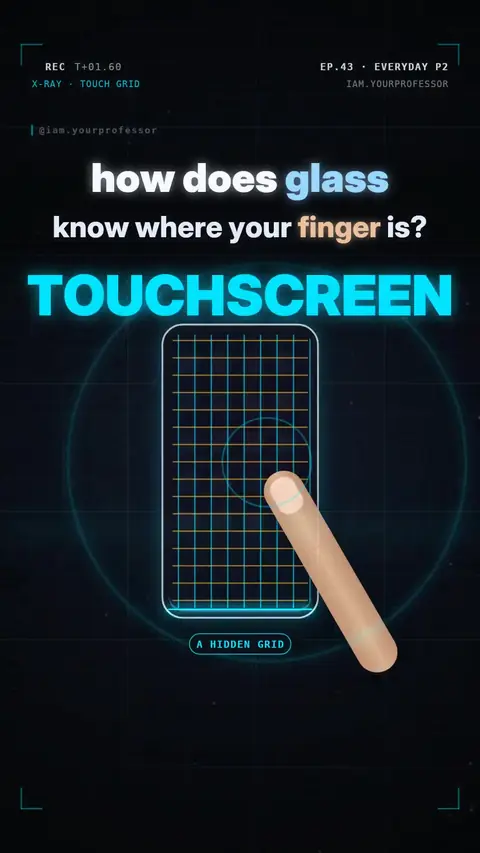
Understand how a grid of transparent electrodes senses the tiny charge your finger pulls (capacitive touch).
How does a piece of glass know EXACTLY where your finger is? 👆📱
1️⃣ UNDER THE GLASS: cover glass on top, a touch grid in the middle, the display underneath. The grid is made of invisible wires (ITO, a transparent conductor): rows and columns.
2️⃣ ROWS SEND, COLUMNS LISTEN: the touch chip sends a tiny signal down one row at a time and measures how much reaches every column at every crossing (shown slowed down).
3️⃣ YOUR FINGER: your body conducts, so your fingertip steals a bit of that electric field at the crossings under it. The signal dips there → the chip works out X and Y. Every crossing is measured separately, so 2 fingers = multi-touch. Real phones scan the whole grid 120+ times a second.
4️⃣ GLOVES: normal gloves are insulators, so your finger can't steal the field → no touch. Touchscreen gloves and styluses have a conductive tip.
No pressure needed. Just charge! ⚡
Read the voiceover (transcript)
- How does glass know where your finger is?!
- Under the glass hides a grid of invisible wires. Rows send a tiny signal, columns listen.
- Your finger steals a bit of that signal. The chip checks every crossing, over a hundred times a second!
- Gloves block it. That's why they don't work!
- No pressure. Just charge!
- Next: why chargers got so small! Follow for part three!
Related lessons



Get new lessons + early access to the full course
One email when new lessons drop. No spam, unsubscribe any time.
✓ You're on the list. Check your inbox to confirm.
By joining you agree to the privacy policy.