Decibels (dB): why +3 dB = double
Why engineers use a log scale, and what +3 dB and +20 dB mean.
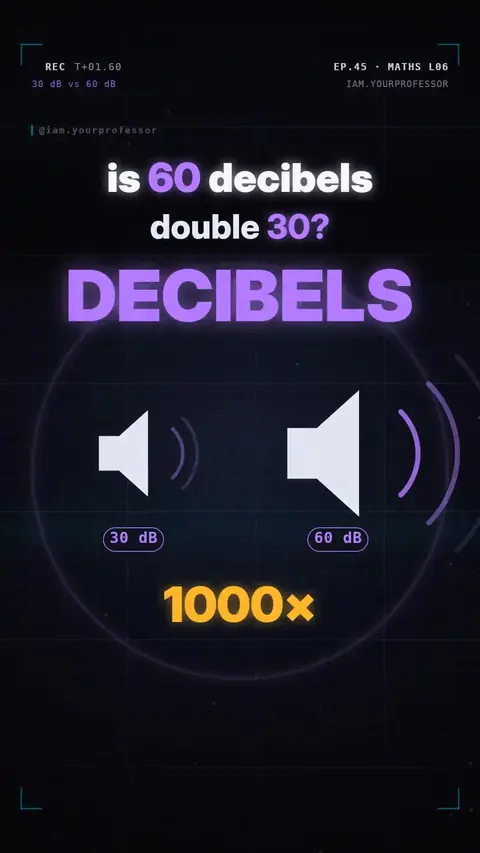
Is 60 dB twice as loud as 30 dB? NOPE: it's 1000× the power! 🔊
1️⃣ THE RULE: dB = 10 × log(P2 ÷ P1). Every +10 dB = 10× the power. So +20 dB = 100×, +30 dB = 1000×. 60 dB − 30 dB = 30 dB → 1000× the power.
2️⃣ DOUBLE = +3 dB: 10 × log(2) = 3.01 dB. So a 100 W amp is only 3 dB louder than a 50 W amp. And −3 dB = HALF the power (that's the "−3 dB cut-off point" of a filter).
3️⃣ WHY ENGINEERS LOVE IT: a whisper ≈ 30 dB, talking ≈ 60 dB, traffic ≈ 85 dB, a concert ≈ 110 dB, a jet engine up close ≈ 140 dB. 0 → 140 dB is ×100 trillion in power, but it fits on one short ruler. (85 dB+ for hours can damage your hearing.)
📌 Remember: +3 dB = 2×, +10 dB = 10×, +20 dB = 100× (power). For voltage, use 20 × log: ×10 volts = +20 dB.
Read the voiceover (transcript)
- Is sixty decibels double thirty?
- Nope: a thousand times the power! Every plus ten decibels is ten times more.
- Double the power? Only plus three decibels! A hundred watt amp is just three decibels louder than fifty.
- That's why one scale fits a whisper and a jet engine!
- Plus three: double. Plus ten: ten times!
- Next: frequency! Follow for lesson eight!
Related lessons
Get new lessons + early access to the full course
One email when new lessons drop. No spam, unsubscribe any time.
✓ You're on the list. Check your inbox to confirm.
By joining you agree to the privacy policy.