RMS: why 230 V really peaks at 325 V
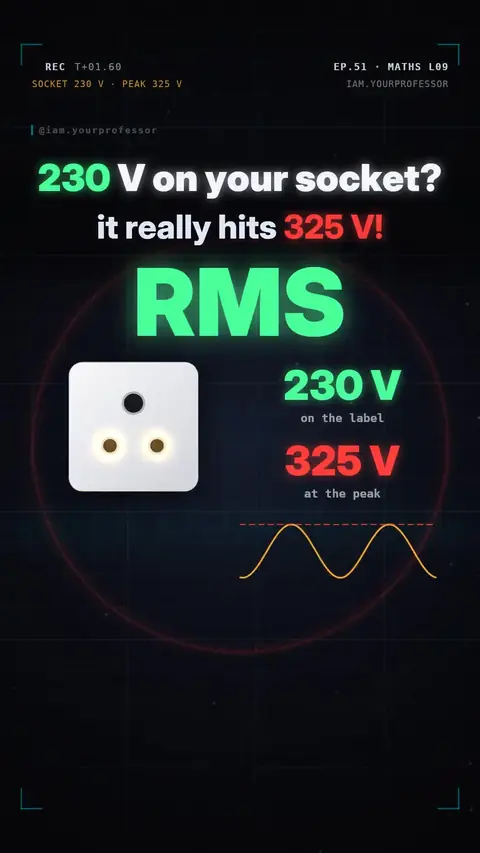
Why AC is quoted as an RMS value (the DC that gives the same heat): 230 V RMS × √2 ≈ 325 V peak.
Your socket says 230 V… but the wave actually hits 325 V! ⚡〰️
1️⃣ PEAK vs AVERAGE: mains is a sine wave. It swings up to +325 V and down to −325 V, 50 times a second. The plus half and the minus half cancel, so its plain average is 0 V. So what is "230 V"?
2️⃣ SAME HEAT: put the same heater on 230 V DC and on 230 V AC. Both give 1000 W, exactly the same heat. That's what RMS (root-mean-square) means: the DC voltage that does the same work. For a sine wave: V(rms) = V(peak) ÷ √2 → 325 ÷ 1.414 ≈ 230 V.
3️⃣ FLIP IT: V(peak) = V(rms) × 1.414 → 230 × 1.414 ≈ 325 V. In a charger, the capacitor after the diodes charges to that PEAK, so it must be rated 400 V, not 250 V.
📌 RMS = same heat as DC. The peak is 1.414× higher (for sine waves).
Read the voiceover (transcript)
- Two thirty volts? It really hits three twenty-five!
- It swings up to three twenty-five, and down again. Its average? Zero!
- Same heat! Two thirty DC or AC warms this heater the same. That's RMS: the peak divided by root two!
- Flip it: times one point four one! Caps need four hundred volts!
- RMS means same heat!
- Next: prefixes! Follow for lesson ten!
Related lessons

Get new lessons + early access to the full course
One email when new lessons drop. No spam, unsubscribe any time.
✓ You're on the list. Check your inbox to confirm.
By joining you agree to the privacy policy.