Tolerance: is your 1 kΩ really 1 kΩ?
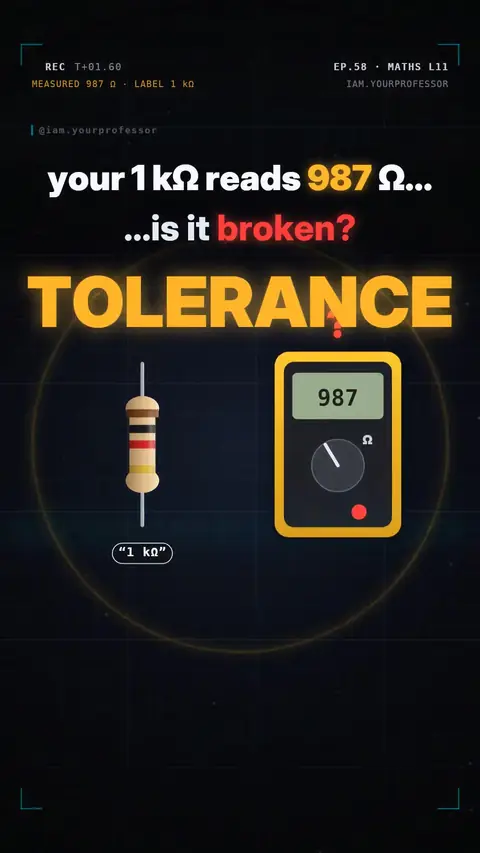
The 4th band gives the allowed error: gold ±5 % of 1000 Ω = ±50 Ω (950–1050 Ω), brown ±1 %; why it rarely matters for an LED.
Your multimeter says 987 Ω on a "1 kΩ" resistor. Is it broken? 🤔
1️⃣ READ THE 4TH BAND: gold means ±5 %. 5 % of 1000 Ω = 50 Ω, so a good resistor can be anywhere from 950 Ω to 1050 Ω. 987 Ω is inside → NOT broken.
2️⃣ A REAL BATCH: measure 20 of them and every one lands somewhere inside that window. Need tighter? A brown 4th band means ±1 % (990 to 1010 Ω). Red = ±2 %, gold = ±5 %, silver = ±10 %.
3️⃣ DOES IT MATTER? An LED on 5 V with a 220 Ω ±5 % resistor (209 to 231 Ω): 3 V ÷ 209 Ω ≈ 14.4 mA, 3 V ÷ 231 Ω ≈ 13.0 mA. Same brightness to your eye.
📌 Tolerance = how far from the printed value a part is allowed to be.
Read the voiceover (transcript)
- Your one k reads nine eighty-seven. Broken?
- No! Gold means plus or minus five percent: anywhere from nine fifty to ten fifty.
- Measure twenty: all inside the window! Want tighter? A brown band is plus or minus one percent.
- For an LED, it barely matters: thirteen to fourteen milliamps!
- Five percent of a thousand: fifty ohms!
- Next: the sine wave! Follow for lesson twelve!
Related lessons

Get new lessons + early access to the full course
One email when new lessons drop. No spam, unsubscribe any time.
✓ You're on the list. Check your inbox to confirm.
By joining you agree to the privacy policy.