// FREE MINI-COURSE · V=IR
Maths for Electronics
The Maths Behind Circuits — Every formula an electronics beginner needs, shown working on a real circuit.
12 of 13 lessons out · next: Radians: why 360° = 2π
▶ Start lesson 1- 01
 Why does a resistor resist current?Rearrange V = I × R to find any one value; more resistance means less current.
EP.09 · 20 s also in Electronics Basics
Why does a resistor resist current?Rearrange V = I × R to find any one value; more resistance means less current.
EP.09 · 20 s also in Electronics Basics - 02
 Voltage divider — create a voltage with mathVout = Vin × R2 ÷ (R1 + R2): make 2.5 V from 5 V with two resistors.
EP.08 · 20 s also in Electronics Basics
Voltage divider — create a voltage with mathVout = Vin × R2 ÷ (R1 + R2): make 2.5 V from 5 V with two resistors.
EP.08 · 20 s also in Electronics Basics - 03
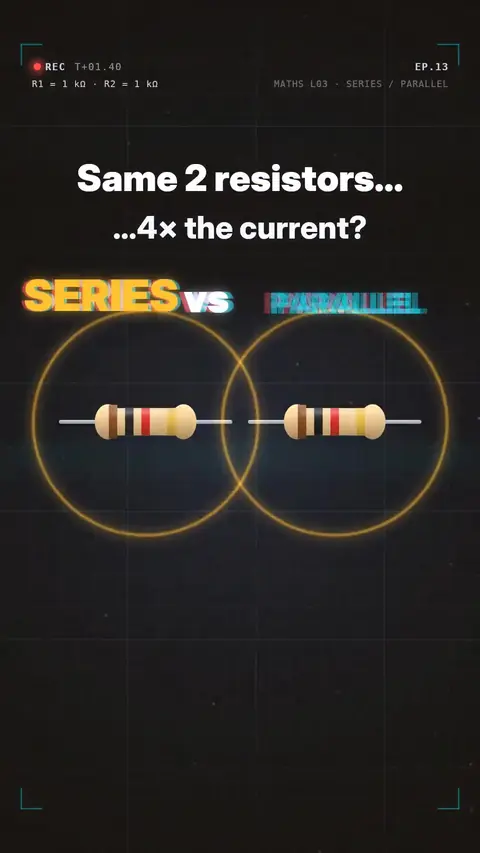 Series vs parallel resistorsSeries: R1 + R2 (2 × 1 kΩ = 2000 Ω). Parallel: (R1 × R2) ÷ (R1 + R2) = 500 Ω — same parts, 4× the current.
EP.13 · 20 s
Series vs parallel resistorsSeries: R1 + R2 (2 × 1 kΩ = 2000 Ω). Parallel: (R1 × R2) ÷ (R1 + R2) = 500 Ω — same parts, 4× the current.
EP.13 · 20 s - 04
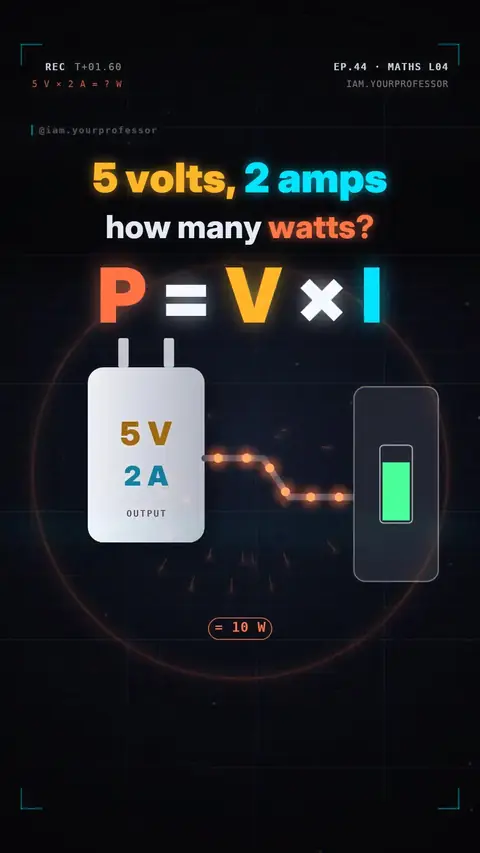 Power: P = V × IWork out how much heat a resistor makes and pick the right wattage.
EP.44 · 24 s
Power: P = V × IWork out how much heat a resistor makes and pick the right wattage.
EP.44 · 24 s - 05
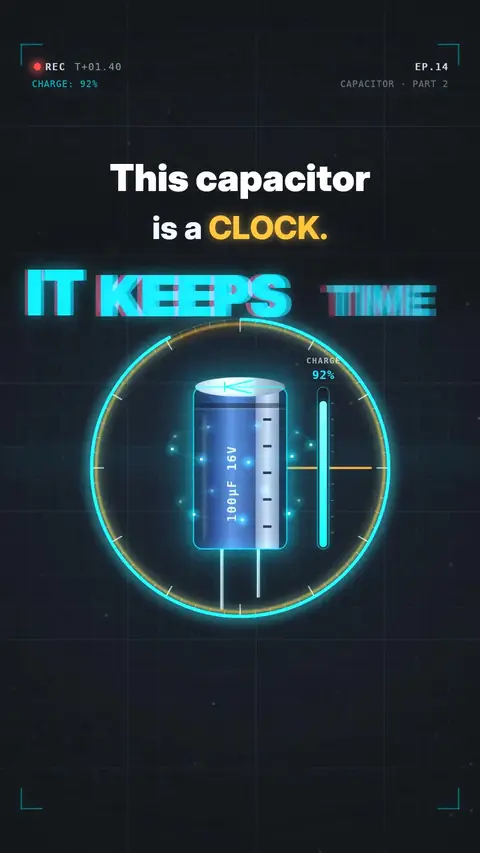 How a capacitor keeps TIMEHow long a capacitor takes to charge, and why 5τ means 'full'.
EP.14 · 20 s also in Capacitor Series
How a capacitor keeps TIMEHow long a capacitor takes to charge, and why 5τ means 'full'.
EP.14 · 20 s also in Capacitor Series - 06
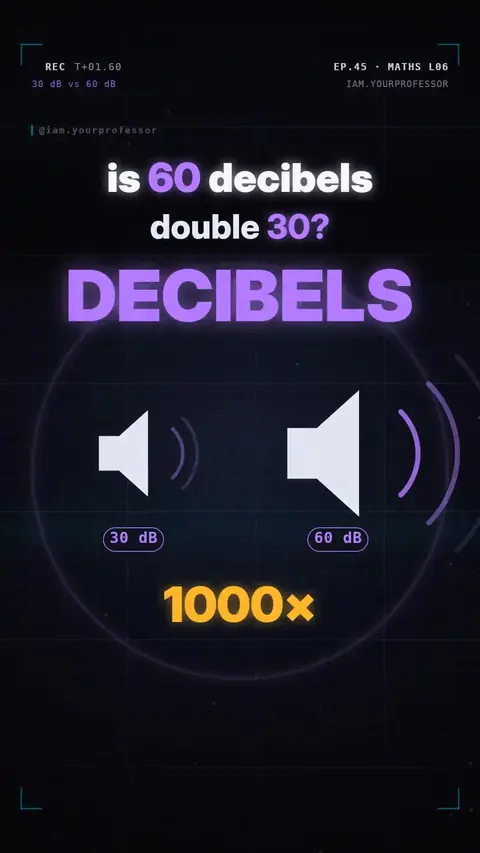 Decibels (dB): why +3 dB = doubleWhy engineers use a log scale, and what +3 dB and +20 dB mean.
EP.45 · 24 s
Decibels (dB): why +3 dB = doubleWhy engineers use a log scale, and what +3 dB and +20 dB mean.
EP.45 · 24 s - 07
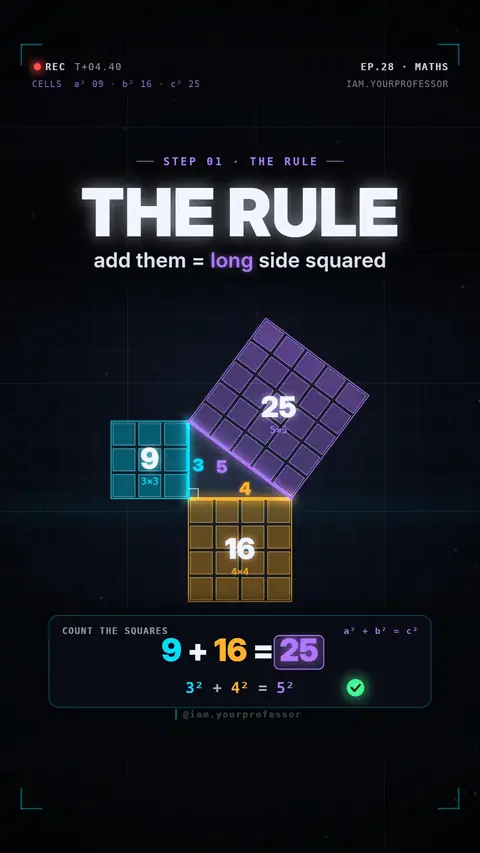 Pythagoras: proof + real lifeWhy a² + b² = c² (slide-the-triangles proof) and where it shows up: TV size, ladders, AC impedance Z = √(R² + X²).
EP.28 · 20 s
Pythagoras: proof + real lifeWhy a² + b² = c² (slide-the-triangles proof) and where it shows up: TV size, ladders, AC impedance Z = √(R² + X²).
EP.28 · 20 s - 08
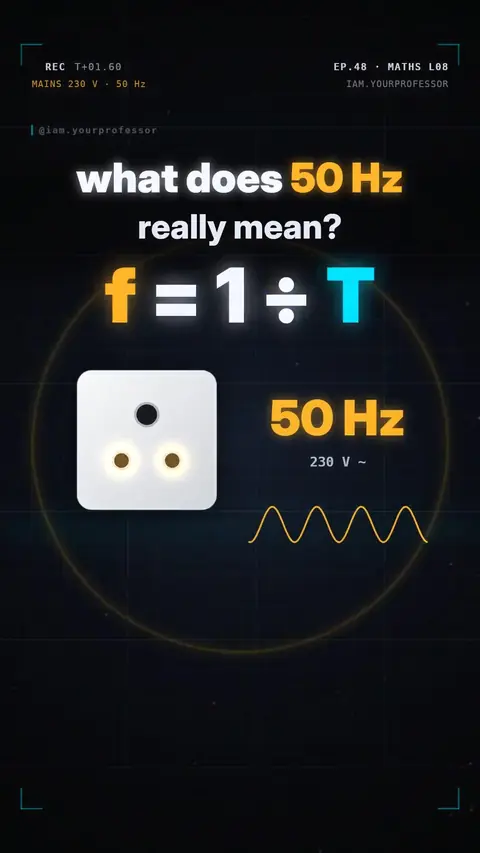 Frequency: f = 1 ÷ TTurn a period into a frequency and back (50 Hz mains = 20 ms, Uno PWM 490 Hz ≈ 2 ms, a 16 MHz clock tick = 62.5 ns).
EP.48 · 24 s
Frequency: f = 1 ÷ TTurn a period into a frequency and back (50 Hz mains = 20 ms, Uno PWM 490 Hz ≈ 2 ms, a 16 MHz clock tick = 62.5 ns).
EP.48 · 24 s - 09
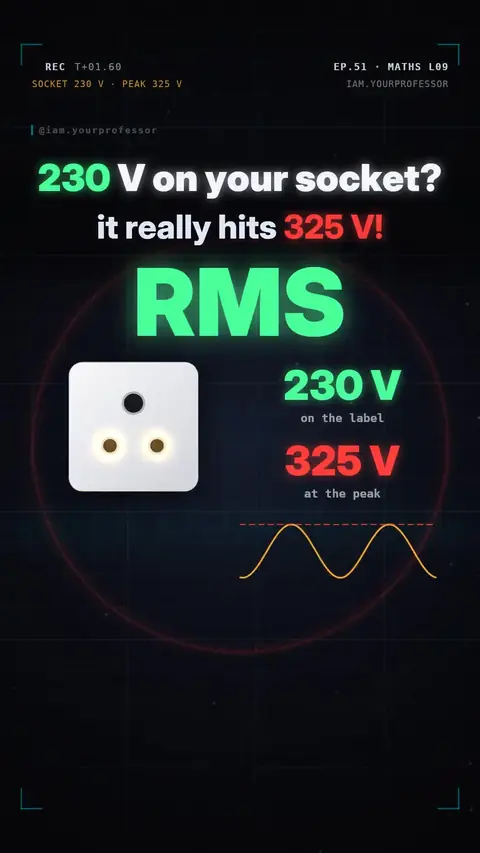 RMS: why 230 V really peaks at 325 VWhy AC is quoted as an RMS value (the DC that gives the same heat): 230 V RMS × √2 ≈ 325 V peak.
EP.51 · 24 s
RMS: why 230 V really peaks at 325 VWhy AC is quoted as an RMS value (the DC that gives the same heat): 230 V RMS × √2 ≈ 325 V peak.
EP.51 · 24 s - 10
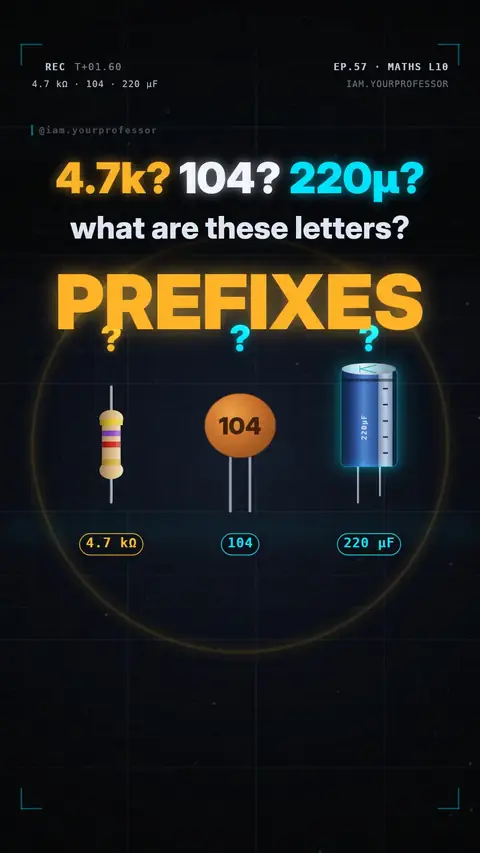 Prefixes: kilo, milli, micro, nanoRead any value on a part: k = × 1000, m = ÷ 1000, µ = ÷ 1,000,000, n = ÷ 1,000,000,000 (4.7 kΩ, 220 µF, 100 nF).
EP.57 · 24 s
Prefixes: kilo, milli, micro, nanoRead any value on a part: k = × 1000, m = ÷ 1000, µ = ÷ 1,000,000, n = ÷ 1,000,000,000 (4.7 kΩ, 220 µF, 100 nF).
EP.57 · 24 s - 11
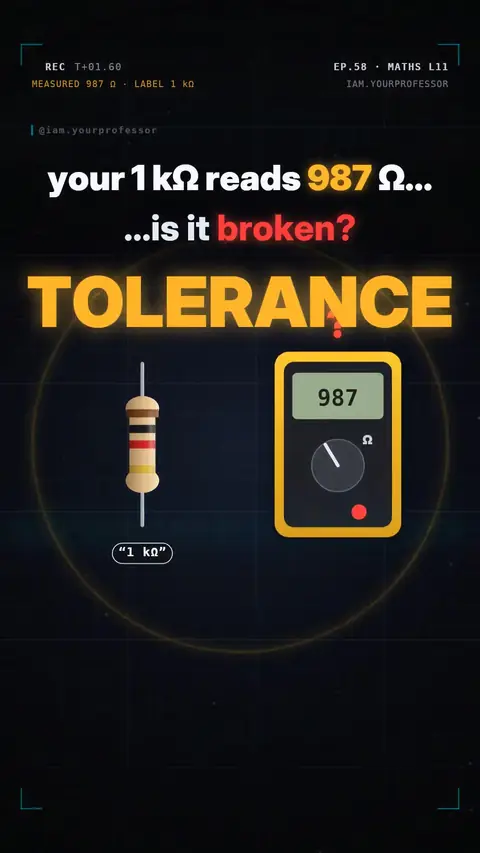 Tolerance: is your 1 kΩ really 1 kΩ?The 4th band gives the allowed error: gold ±5 % of 1000 Ω = ±50 Ω (950–1050 Ω), brown ±1 %; why it rarely matters for an LED.
EP.58 · 24 s
Tolerance: is your 1 kΩ really 1 kΩ?The 4th band gives the allowed error: gold ±5 % of 1000 Ω = ±50 Ω (950–1050 Ω), brown ±1 %; why it rarely matters for an LED.
EP.58 · 24 s - 12
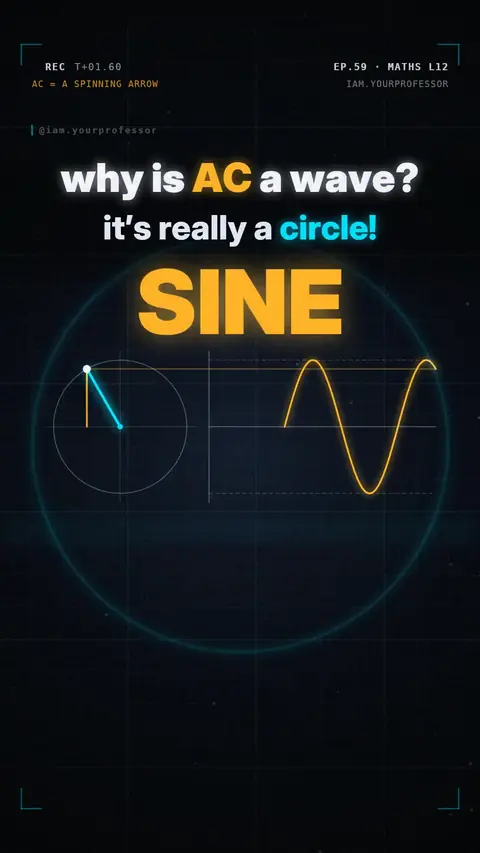 The sine wave is a spinning circleSine = the height of a spinning arrow; 1 turn = 360° = 1 cycle (50 turns/s = 50 Hz mains); sin² + cos² = 1 is Pythagoras.
EP.59 · 24 s
The sine wave is a spinning circleSine = the height of a spinning arrow; 1 turn = 360° = 1 cycle (50 turns/s = 50 Hz mains); sin² + cos² = 1 is Pythagoras.
EP.59 · 24 s - 13 COMING NEXTRadians: why 360° = 2πOne radian is the angle where the arc equals the radius (≈ 57.3°), a full turn is 2π radians, which is why AC formulas use 2πf.
// NEWSLETTER · FREE
Get new lessons + early access to the full course
One email when new lessons drop. No spam, unsubscribe any time.
✓ You're on the list. Check your inbox to confirm.
By joining you agree to the privacy policy.